
Introducing WezTerm
WezTerm is a powerful cross-platform terminal emulator and multiplexer written by @wez and implemented in Rust
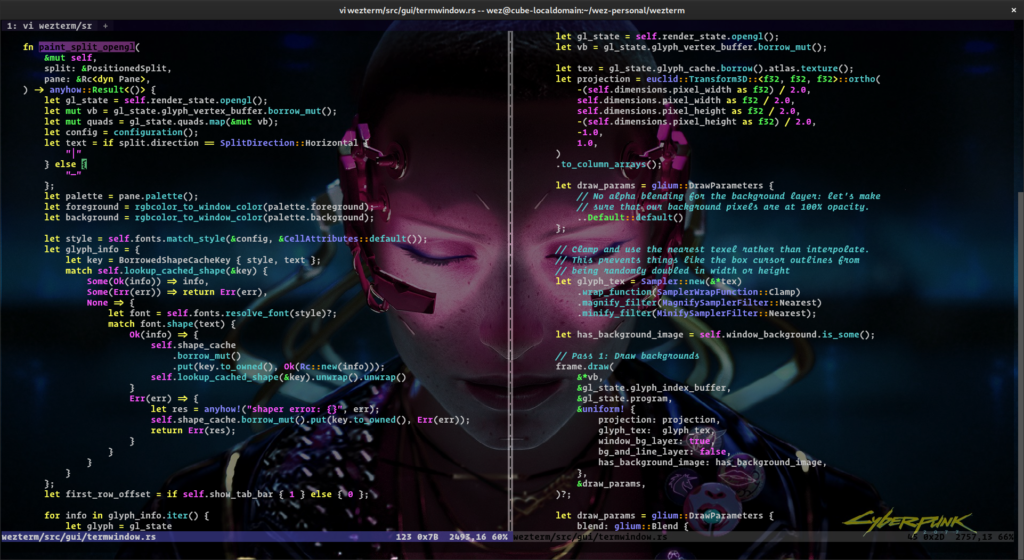
The Architecture: A Scriptable, Lua-Driven Engine
WezTerm completely departs from traditional configuration parsing by embedding a full, bare-metal Lua runtime engine into its core. Written entirely in Rust, the application treats its configuration file (wezterm.lua) not as a static text file, but as an executable program that runs instantly on startup and automatically hot-reloads on every save.
                    ┌─────────────────────────┐
                    │      wezterm.lua        │
                    │   (Lua Runtime Code)    │
                    └────────────┬────────────┘
                                 │
                ┌────────────────┴────────────────┐
                ▼                                 ▼
      ┌───────────────────┐             ┌───────────────────┐
      │  Rust GUI Core    │             │ Multiplexer Daemons│
      │ (EGL/Vulkan/wgpu) │             │  (Local & Remote) │
      └───────────────────┘             └───────────────────┘
This structural execution layer shifts the paradigm of terminal customization:
- Dynamic Configuration: Because you have access to a full programming language, your terminal environment can change programmatically based on the time of day, system-level appearance hooks, or environment variables.
- Decoupled Multiplexing: WezTerm includes its own built-in multiplexer daemon. It can split panes, manage tabs, and handle windows locally or spawn persistent headless domains over remote servers—retaining your layout state even if your connection drops.
Platform-Specific Focus: Pure Hardware Acceleration
Unlike terminal emulators constrained to a single operating system, WezTerm is built to deliver identical, uncompromising performance across Linux, macOS, Windows (10/11), FreeBSD, and NetBSD.
- The Rust Graphics Pipeline: Rather than using native OS toolkit drawing models (like AppKit or GTK), WezTerm builds its own visual environment using a hardware-accelerated rendering pipeline backed by wgpu (WebGPU API).
- Direct GPU Processing: By taking direct control of the GPU via Vulkan, Metal, or DirectX, text rendering, dense animations, and heavy data scrolling bypass the CPU entirely to maintain fluid framerates under extreme output stresses.
- Unified Visuals: Because it bypasses the host OS GUI toolkit, WezTerm looks, scales, and renders identically whether you are running it on a Mac notebook, a Linux workstation, or a native Windows environment.
Deep Technical Integration & Features
WezTerm acts as an advanced command-line workspace, blending advanced font manipulation mechanics with built-in remote server awareness.
Advanced Typography & Media Controls
A defining technical pillar of WezTerm is its native handling of modern typography. It natively processes complex font ligatures, configures granular font fallbacks automatically (substituting alternate fonts if an emoji or special symbol is missing), and completely supports inline graphic rendering using both the Kitty and iTerm image protocols.
Feature Matrix
| Feature Domain | Capabilities | Highlighted Workflows |
| Ecosystem & Remote | Native multiplexing and built-in protocol support. | Connects directly to remote machines using built-in SSH clients or hooks directly into hardware Serial Ports (useful for embedded development and interacting with microcontrollers). |
| Interactive Navigation | Built-in window overlays without leaving the keyboard. | Includes an interactive Quick Select Mode to instantly extract and copy text/URLs visible on screen using keyboard shortcuts, alongside a dedicated, searchable vim-like Copy Mode. |
| Optics & Aesthetics | Dynamic color handling and window styling. | Out-of-the-box support for hundreds of built-in color schemes, transparent window blurs (RGBA/alpha blending), and real-time HSB (Hue, Saturation, Brightness) adjustments for background wallpapers. |
Behind the Code: An Independent Open-Source Project
WezTerm is a completely free, open-source project released under the permissive MIT license. The project was started, designed, and remains actively spearheaded by its primary creator, Wez Furlong (@wez), alongside a global community of open-source contributors.
It stands as an ambitious cross-platform tool constructed in Rust, prioritizing maximum customizability, extreme performance stability, and absolute configuration parity regardless of what operating system you find yourself on.